Peter Nanos
Healthcare Technology Executive
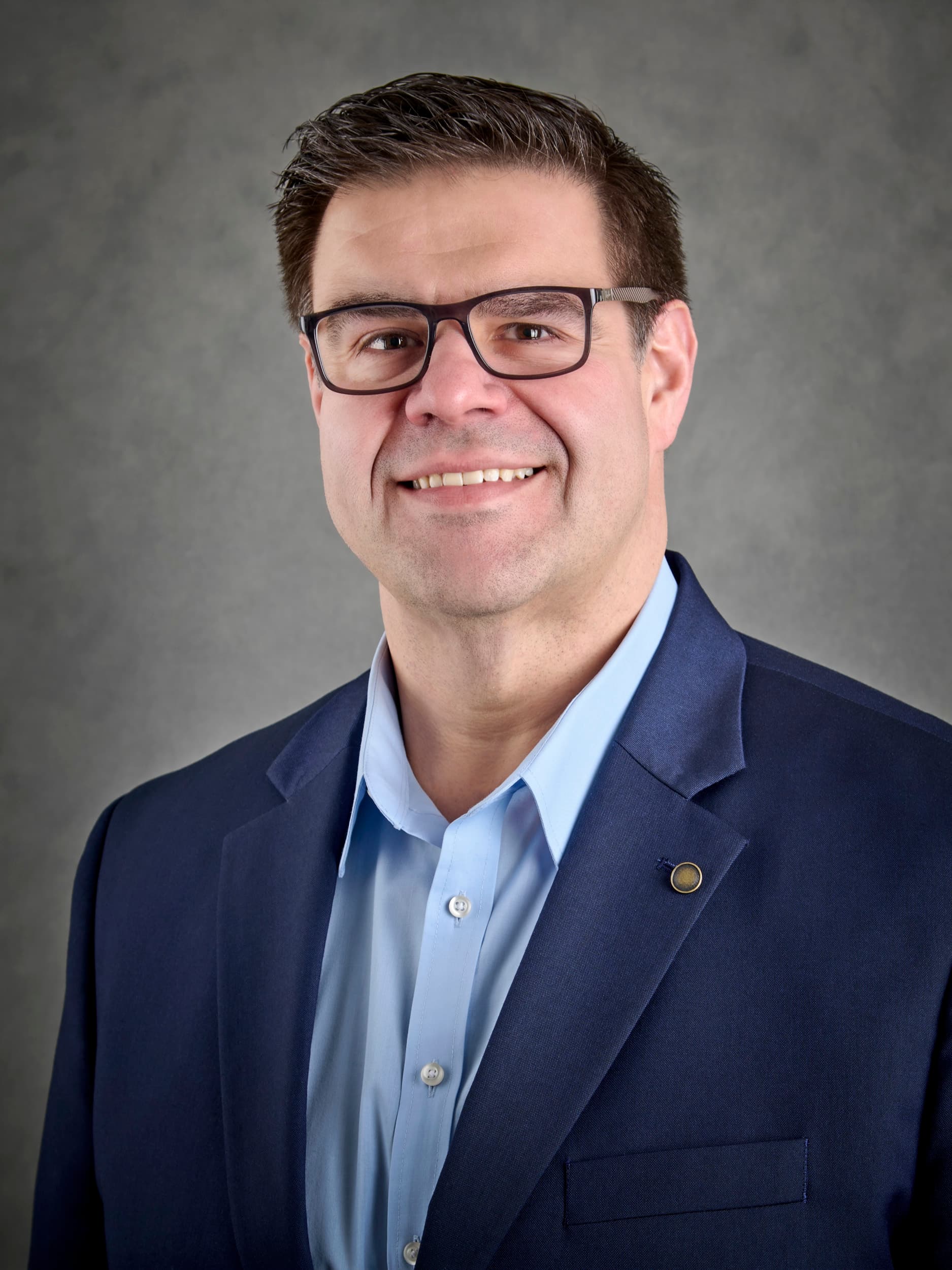
Twenty years of building systems that help patients get the care they need. What follows is how I got here, the long way around.
The Beginning
Our first computer showed up when I was eleven. A friend of my dad's was selling computers and my dad wanted to support him, so we got one. PCs were expensive then. This was a real purchase, not a hand-me-down. My dad's friend came over and spent the whole day setting it up. He installed apps off the giant slow floppy disks they came on back then, and put a little DOS menu tool on top so we could launch them by number. I watched all of it.
Fun fact: my first computer was a Compaq 286 with a 20-megabyte hard drive and 640 kilobytes of RAM. The latest iPhone in your pocket has roughly 10,000 times more processing power.
A few days later I was reading the manuals. Three giant ones that came in the box. I mistakenly ran a command that formatted the hard drive. Wiped everything. The apps, the menu, a whole day of his work. I was eleven, the computer had cost real money, and I did not want to get in trouble for breaking it.
I had the disks. I reinstalled the apps. But the menu tool wasn't in the box anywhere. That had been his thing. So I read enough of the manual to write my own. Rudimentary, but it worked. Apps launched by number, same as before.
When my dad's friend came back to check in, he turned the machine on, saw a menu he didn't recognize, and asked what it was. I told him. He wasn't upset. He was proud.
That's the moment I learned the world rewards making.
As a kid I drew cars and planes and helicopters. My parents thought I'd make a good architect, and the idea stuck. I took drafting in high school because it was the closest thing they offered, and the drafting room had two computers that could do three-dimensional drafting for the whole class to share. I was more interested in the computers than the drafting, but I didn't know that yet.
I went to UW-Milwaukee for architecture. The more time I spent in the program, the more I realized it was about art, not tech or engineering, and the art part wasn't where my head was. So when my parents got me a Compaq with Windows 95 to help with my papers, the computer became my real teacher. Months of reinstalling the OS from those twenty-five floppy disks, learning every menu from memory. Modems and bulletin boards I'd seen before, but this thing connected to the actual internet through the campus phone system, and I was hooked. My grades sagged. I wasn't failing. I was just locked in my dorm reading manuals instead of going out.
Eventually I switched majors to Production Operations Management. POM was about manufacturing process improvement. We learned the methods, their history, and how to apply them. Lean, flow, throughput, bottlenecks. That switch shaped how I think more than any single decision in my career. It trained me to write down the rules of a system before designing inside it. First-principles thinking that produces guiding principles. Twenty years later I still build platforms that way, and it's why they actually deploy.
I paid for college on the help-desk at the Adult Education extension, where the real computer guys took me under their wing. Networking, partition scripting, early Linux. Faculty started asking me to teach them how to use Netscape email. I started a side consulting gig. I never stopped doing that either.
I picked POM because the plan was to come home, work in my dad's pizza business, and help him scale it by adding locations. He and my mom had come to this country as immigrants and fell into the pizza business. He'd built it from nothing and put me and my sisters through college on it. POM was the degree that would prepare me to scale it. That was my first attempt at scaling a business, even if it never got off the ground.
When I got home, it became clear my dad wasn't ready to hand over the keys. The pizza business was his sport. My mom sat me down and told me to do something I was actually passionate about. She reminded me how she and my dad had built their life: not by following a plan, but by making the thing in front of them work. She wanted that for me too.
So I took her advice and got a job in computers. I landed at a small tech company in Chicago. No formal computer degree, so they handed me the A+ exam. I aced it. They still had me running UPS deliveries for a while before letting me fix printers and laptops, and eventually putting me out in the field as a tech. That's how I ended up at the University of Chicago, as a consultant on their help desk.
I think part of why I'll never stop working is that I watched my dad never stop. The pizza business was his sport. Computers became mine. If you're enjoying 30% of your job, you've got the job of your dreams. It's not called work for nothing. The rest of the time, they call it fun, or a hobby.
Then I went to work in healthcare, where the systems that needed building were the ones standing between patients and the care they needed.
University of Chicago Medicine
I joined University of Chicago as a help-desk consultant from a small tech company in Chicago. I was supposed to be a field tech. I ended up staying for a decade.
The job was making sure the desktop PCs throughout the hospital actually worked. That sounds modest. It wasn't. The doctors had become dependent on those computers for everything. The patient's history, the documentation of every interaction, the orders, the results. The computer wasn't a tool sitting next to the care anymore. It was inside the care. And if I couldn't keep those computers running, patients couldn't get care.
That landed for me at a help-desk level first, as an idea. It got more visceral later.
I climbed inside the help desk. Rep, then team lead, then interim manager running about fifteen people. I was twenty-four. I made my case to be made permanent and the CIO brought somebody in from outside instead. He told me I had more growing to do.
Around the same time I'd become the hospital's hardware-and-OS guy on the help desk side. That's how I got pulled into the bigger projects of the era while still on the help desk.
The first was OpTime. Surgery was rolling out Epic OpTime and needed a digital replacement for the literal grease pen whiteboard the OR used to track patient flow through the surgical stages of the day. The hardware problem was real. We needed a computer that would boot itself, recover from failures, run unattended twenty-four-seven, be fully remote-controllable, drive an array of eight twenty-inch wall-mounted monitors, and live in a custom-cooled enclosure next to the screens. Multi-display video cards were scarce. Headless self-recovering kiosks were not standard. I designed the hardware, the enclosure, the cooling, the OS image, and the remote-control layer. Epic built the HTML pages that auto-launched at boot and snapped across the monitors to show patient surgical trajectory in real time.
Together we replaced a grease pen on a wall with a live electronic dashboard. Epic later marketed the design.
Then OpTime went live in the actual ORs. Epic was running on laptops at the bedside, pulling the patient's record so the surgeons had everything in front of them. Those laptops would occasionally malfunction. I'd get called in. Which meant I'd suit up in the protective gear and stand in an OR while a patient was anesthetized, chest open, and troubleshoot a laptop in the corner of my vision while the surgical team kept working.
That's when it stopped being an idea. It was the patient on the table relying on me to make the laptop work. That moment never left me, and I used it for years afterward to motivate my teams. Imagine that's your relative on the table. What would you want the IT person to do?
Imagine that's your relative on the table. What would you want the IT person to do?
After OpTime came Filmless. Radiology was going digital, and we rolled out diagnostic displays to physicians' work rooms across the hospital and stood up the first PACS, Amicas, alongside the existing Cerner RIS. $1.5M project. Filmless is where I met the Radiology AD, who later recruited me into the department.
I came into Radiology as a peer to the managers of RIS, PACS, and the PMO. I worked for Paul Chang. Paul invented Stentor PACS. He ran the radiology informatics group, and he became a mentor as I grew into the department. When the Assistant Director role opened, I applied and got it. The other managers I'd been peer to now reported up to me.
Paul and I talked about the org. He felt we needed more doers, not more managers. I agreed. So I flattened the structure. Roles changed, the team got leaner, and the department got faster.
That was the first time I made an org structure decision instead of a technical one. It looked like the right move because Paul and I had the same read. It worked because we executed it together with the physician leadership of the department.
In Radiology, the patient-care frame transferred to wet reads. A wet read is when a patient is on the scanner with an emergency presentation and the radiologist has to read the images straight off the modality, before any asynchronous workflow kicks in. Stroke. PE. The kind of read where minutes matter. Same frame I'd carried out of the OR. That patient could be your relative. What would you want the system to do?
Once I understood the stakes, I built what the department needed.
I architected an SOA-governed Enterprise Service Bus that normalized all HL7 data into a warehouse and wrapped it in secured web services. We instrumented Epic's Chronicles log files to capture clinical events Epic didn't expose natively. That gave us a clean substrate for ninety in-house .NET and C# applications layered on top of Epic. Radiology Worklist wrapper. VIB, our mammography module replacing Epic's native one. Closed Loop Imaging. Biopsy Tool. Pathology Results Tool. Lab Results Tool. Best-practice alerts. Early clinical decision support.
We also delivered the platform implementations the department needed to run: Philips iSite PACS, Commissure / Nuance DVR, ACUO VNA, CodeRyte automated billing. I led UChicago's Epic Radiant implementation as part of the $95M EMR program, the first module live. Radiant Certified, 2012.
Then I left to go run product at Merge Healthcare. That's the next chapter.
iConnect Network at Merge Healthcare
The idea started at UChicago.
A colleague in the billing office flagged growing denial rates on imaging exams. I pulled the reporting and found the cause. About 65% of our imaging exams were touched by a radiologist during protocoling. The radiologist would review a scheduled exam a day or two out and modify the order to properly answer the referring clinician's question. Change body part, add contrast, change modality. That protocol change broke prior auth. AIM was forgiving; an authorization was good for the day regardless of specific changes. EviCore was strict; authorizations were body-part-specific with separate auth numbers, and a protocol change invalidated the original. The exams went out, the bills went out, and we got hit with denials that then forced us to chase retro-auths we had little chance of winning. UChicago was bleeding money on it.
The community side was worse. Community referrals came in by fax server. The faxes weren't lost. They were handwritten orders. Someone on our side had to translate doctor handwriting into a structured order before the work could move. Humans make for horrible integrating agents. Computers are more precise. The community patients traveling to UChicago were our sickest, which meant the highest-acuity, highest-margin imaging was operationally worst served.
Humans make for horrible integrating agents. Computers are more precise.
I saw it as one problem, not two. The fix was a platform that could accept electronic referrals from community providers, automate prior authorization against the radiology benefit managers, normalize and route the clinical data needed for medical necessity review, and return reports and image access electronically. Close the loop between referral, authorization, and billing.
I called it Closed Loop Imaging. From the moment a provider had a question about their patient that imaging could answer to the moment they got their answer.
I pitched it to UChicago's investment committee. They weren't yet equipped to take it on.
So I made a deliberate move. I'd had the idea on the provider side, but I knew I didn't yet have what it took to build the company commercially. I needed to learn product and solutions management, the vendor side, what a real software company does. I joined Merge Healthcare to cut my teeth and earn the credibility to be heard. Then I pitched it again, inside Merge, after I'd done the work.
That's the version that became iConnect Network.
It launched in 2013 at RSNA. A cloud-based multitenant radiology workflow platform that managed referrals, clinical reports, clinical decision support, prior auth automation, and VPN-less interoperability. It was later renamed from Closed Loop Imaging to iConnect Network to align with iConnect Cloud Archive, which I also product-managed.
I designed it with a few principles I wrote down before the architecture.
Don't duplicate data. Facilitate consumption of it.iConnect didn't try to be the system of record. It moved data between systems of record and made the right data available at the right step in the workflow.
No VPNs. Use port 443 polling.Customer IT teams shouldn't have to do firewall work to deploy our platform. We met the customer's network where it already lived.
Hub and spoke. iConnect was the hub. Imaging centers and referring providers were the spokes. The alternative was point-to-point connections between every referrer and every imaging center, which nobody could afford to build and nobody could afford to maintain. One hub solved it.
All three came from POM thinking. Write the rules of the system down, then design inside them. They're why iConnect actually deployed at scale.
By 2015 it had its own business unit at Merge, called iConnect Network Services. Three offerings: iCNS Orders, iCNS Authorize, iCNS Results. The framing was straightforward. In 81% of cases where imaging claims got denied, the denial traced to prior auth. Physicians and admin staff were dedicating 10 to 20 hours a week to manual auth tasks. Almost half of imaging referrals never materialized into a patient appointment because of lost faxes and lack of follow-up. iCNS attacked the whole loop.
The hard part was the prior auth automation. That required getting two competing radiology benefit managers, AIM Specialty Health and EviCore, to expose APIs into the same provider workflow. AIM had never exposed an external API to anyone before us. Our CEO and Chief Product Officer had relationships at AIM and EviCore that opened the door. I built the integrations that walked through it. AIM at that point served 42 million members through health plans across all 50 states. Bringing them into a vendor-neutral provider workflow, alongside their direct competitor, was unusual. It worked because it was good for both payers and providers and we engineered it to require minimum lift on either side.
The mechanic underneath the AIM-EviCore bridge, the routing logic that decided which RBM to call, when, with what payload, and how to reconcile the response back into the order workflow, became U.S. Patent 9,928,339, Methods and Systems for Routing Image Reports.
I also wrote about the broader problem for AuntMinnie in 2017: 3 reasons to re-evaluate your prior authorization strategy.
iConnect Network scaled past 100 customers in production and grew steadily through 2017. We extended the network through MedAllies and its National Direct Network.
While iConnect was scaling, I also owned Merge's corporate relationship with Epic. Epic's interoperability ranking for Merge wasn't where it should be, and I wanted to fix that.
My principle was that our products needed to work better inside Epic itself. Frictionless. Most of our competitors were launching into separate windows, which broke the clinician's flow and broke Epic's design principles. I knew that if our integrations lived inside Epic the way Epic wanted them to, our customers would feel the difference, and Epic would too. So I re-established quarterly joint product improvement meetings at Epic HQ in Verona, Wisconsin, and we worked through every product to make it integrate cleanly, not just interoperate.
Within a few cycles Epic named Merge their #1 Interoperability Partner. The recognition was for both: interoperability and integration.
Across the Merge product line I also delivered a 66% hardware consolidation using VMware. PACS, VNA, Document Management, Image Viewer. Server footprint went from 16 to 4.
In 2015 IBM acquired Merge for $1B and folded it into IBM Watson Health Imaging.
One contract clause from before the acquisition mattered more than anyone outside the company realized. I'd negotiated secondary-use data rights into every iConnect Network and iConnect Cloud Archive customer agreement and renewal. The rights were narrow and respectful, but they were there. After the acquisition, that clause was what enabled Merge's longitudinal imaging dataset to support AI model training inside IBM. The acquisition thesis assumed access to imaging data at scale. The contract architecture I'd put in place was what made it real.
After the acquisition I won IBM's Watson Health Disruptor forum, first place out of 500 entrants, for a prior auth concept with seed funding for value-proof discovery. I moved into IBM Offering Management roles after that, running iConnect Network and iConnect Cloud Archive at IBM scale, and later leading IBM Cloud Pak for Data as a Service and the Cognos Analytics on-prem-to-cloud migration program.
Then I left IBM to go run product on the payer side at Anthem. That's the next chapter.
Health OS at Anthem
I left IBM to run product on the payer side at Anthem, on a platform called Health OS.
Anthem's Health OS is its bi-directional clinical data interoperability platform, the layer that pulls clinical data from provider systems back into the payer to feed everything Anthem does with that data downstream. Stars. HEDIS. Risk adjustment. Prior authorization automation. Care management. The platform connects more than 10,000 providers, nearly 100 large health systems, and serves more than 45 million members. It also integrates with the Epic Payer Platform, which is how a lot of payer-side Epic deployments consume clinical data at scale.
I joined as a Senior Product Manager and over three years moved into Director of Product Management and Engineering, then Director of IT Strategy and Innovation. I ran product for the data layer underneath everything else, plus the partner program built on top of it.
The first big call I made on the data layer was architectural. The platform had to choose between point-to-point integrations with each EMR endpoint or an endpoint-agnostic abstraction layer that would let downstream consumers query a normalized model regardless of where the data originated. Point-to-point would have been faster to ship per integration. It also would have capped coverage at maybe 10-15% of the provider footprint inside a year, because the integration-per-endpoint cost compounds.
The endpoint-agnostic abstraction layer was the right call. It cost more to build at the start. It scaled.
Health OS was a 150+ engineer org. The data layer work was matrixed to me. Get the data layer's KPIs right, latency, completeness, lineage, and the Stars, HEDIS, risk adjustment, prior authorization, and care management teams could consume the same source of truth instead of building one-off extracts. Get them wrong and nobody downstream survives a CMS audit. The architectural call shaped what every team could build.
Health OS got referenced multiple times in Elevance earnings calls during my tenure.
Get them wrong and nobody downstream survives a CMS audit.
The second part of my work was the Partner Program.
Anthem's data science team had built a set of predictive algorithms that could identify at-risk members across a range of conditions. Pre-diabetes scoring. Population-health risk stratification. Real models, real outputs. The question was how to get those algorithms to actually bend outcomes for the members they were scoring.
I conceived and launched the Health OS Partner Program to commercialize that capability through external partners. Post-acute providers, population-health platforms, care management organizations. Partners that already had relationships with the right members and were equipped to act on a risk score. Anthem's data science team had built the math; my program built the channel.
In my last role at Anthem I served as tech lead and product manager on the Veterans Administration federal RFP, a $72B+pursuit where Health OS was positioned as a cornerstone capability. I designed the workflows and the technical architecture for referrals through VA's Community Care Network, integrating VistA EMR with the Health OS data layer. I also coordinated the program managers across the response and pulled the non-technical teams through their deliverables, reporting up to the executive who owned the bid.
The VA work also pulled me into industry standards conversations with NCQA and major health systems on what clinical data quality has to look like to support payer use cases at federal scale.
I left Anthem because I wanted to operate closer to the patient again. Back to the front lines, like at UChicago. That's the only way to know what's actually happening and what problems really need solving to help patients get the care they need. So I stepped into a full operator seat in a PE-backed environment, first at Duly Health and Care, then at Summit Professional Education. That's the next chapter.
Duly Health and Care
After Anthem I joined Duly Health and Care, an Ares Management portfolio company. Duly is an ambulatory health system across 180 locations, provider-led, with both fee-for-service and value-based care populations. I led EMR technology in lockstep with the clinical leadership, because in a provider-led organization clinical priorities have to drive technology priorities. I delivered a multi-version big-bang Epic upgrade across all 180 locations. I owned execution on a concurrent billing platform replacement initiative that went through cutover with cash collections protected. The combination of Epic at scale, a parallel financial system replacement, and the operational realities of a roll-up grown through acquisition was the most operationally complex chapter of my career so far.
Summit Professional Education
I'm now Chief Technology Officer at Summit Professional Education, an Avathon Capital portfolio company. Summit is a multi-brand healthcare continuing education roll-up, and I own the full technology stack across the portfolio: enterprise systems, cloud, data, security and compliance, payments and subscriptions, digital experience. I report to the CEO and partner with the board on integration sequencing, product rationalization, and technology investment strategy across acquisitions. The work is the work my POM training prepared me for, twenty years on. Write the rules of the system down. Design inside them. Build the technical foundation that lets acquisitions scale without breaking what's working.
The thread that ties all of it together is still the same one I picked up in the operating room at UChicago. Build the systems that help patients get the care they need. Everything else is a chapter of that.
Advisory & Board
I advise healthcare and technology founders on platform architecture, post-acquisition integration, and the moments where technical depth changes the business outcome.
Open to board, board-observer, and tech diligence engagements with the right healthcare technology and PE-backed companies.